













Large-scale reconfigurable photoelectric reservoir computing based on programmable silicon photonics chips
Introduction: At a time when the demand for AI computing power is growing exponentially, optical computing is highly anticipated for its ultralow latency and high energy efficiency. Reservoir Computing (RC) is a hardware-friendly, training-efficient computing paradigm. However, existing optoelectronic reservoir computing systems are often constrained by fixed topological connections, making it difficult to demonstrate sufficient flexibility across complex and variable tasks.
Recently, the team of Nan Chi, Haibin Zhao, and Ziwei Li from Fudan University, in collaboration with Lightelligence, published their latest breakthrough results in the top journal Laser & Photonics Reviews. On the programmable silicon photonic computing engine (PACE), the research team integrated 64 physical nodes and tunable interconnection topologies, enabling a reservoir structure that can be flexibly configured according to computational needs. This research provides a scalable, task-adaptive solution for high-speed neuromorphic computing and further advances the practical deployment of photonic intelligence.
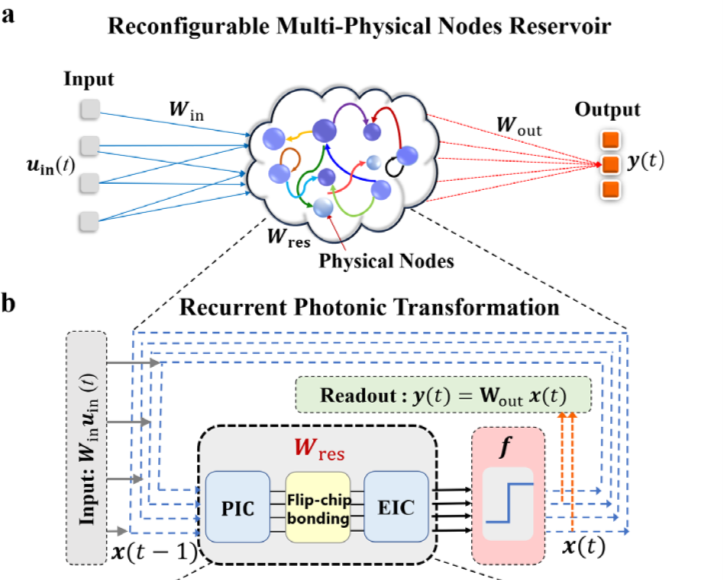
Figure 1: Schematic architecture of reservoir computing and the proposed dynamic state evolution mechanism of optoelectronic reservoir computing
☆ Core Pain Point: Why does optoelectronic reservoir computing need to be “reconfigurable”?
Reservoir computing (RC) is a recurrent neural network variant that is extremely hardware-friendly, with its core advantage being that only the output layer weights need to be trained, while the internal connection weights of the reservoir are fixed and sparse. Prior to this work, the mainstream optical RC implementations in the industry fell into two main categories:
Time-delay RC (TD-RC): A single physical node is time-multiplexed to emulate multiple nodes. While fast, the coupling among virtual nodes is constrained and lacks flexibility.
Multi-physical-node parallel RC (MP-RC): Combines passive devices such as micro-ring resonators (MRRs) or multimode interferometers (MMIs). Although it offers inherent parallelism, the dynamic properties are difficult to adjust when implemented through passive interconnects, and the approach faces scaling challenges, with the node count typically limited to under 32.
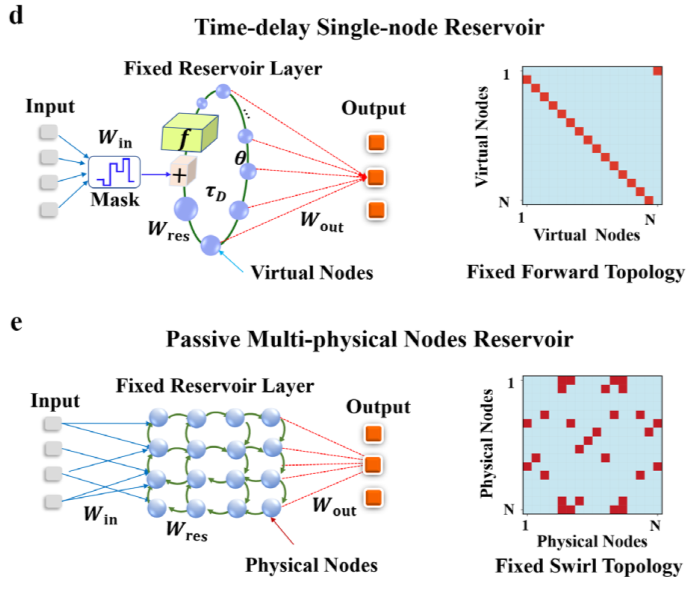
Figure 2: Schematic diagrams of TD-RC and MP-RC
To accommodate diverse computing tasks, breaking free from the constraints of fixed hardware topology becomes the key to overcoming the bottleneck.
☆ Hardware and Architecture Innovation: Large-Scale Deep Evolution Based on the PACE Platform
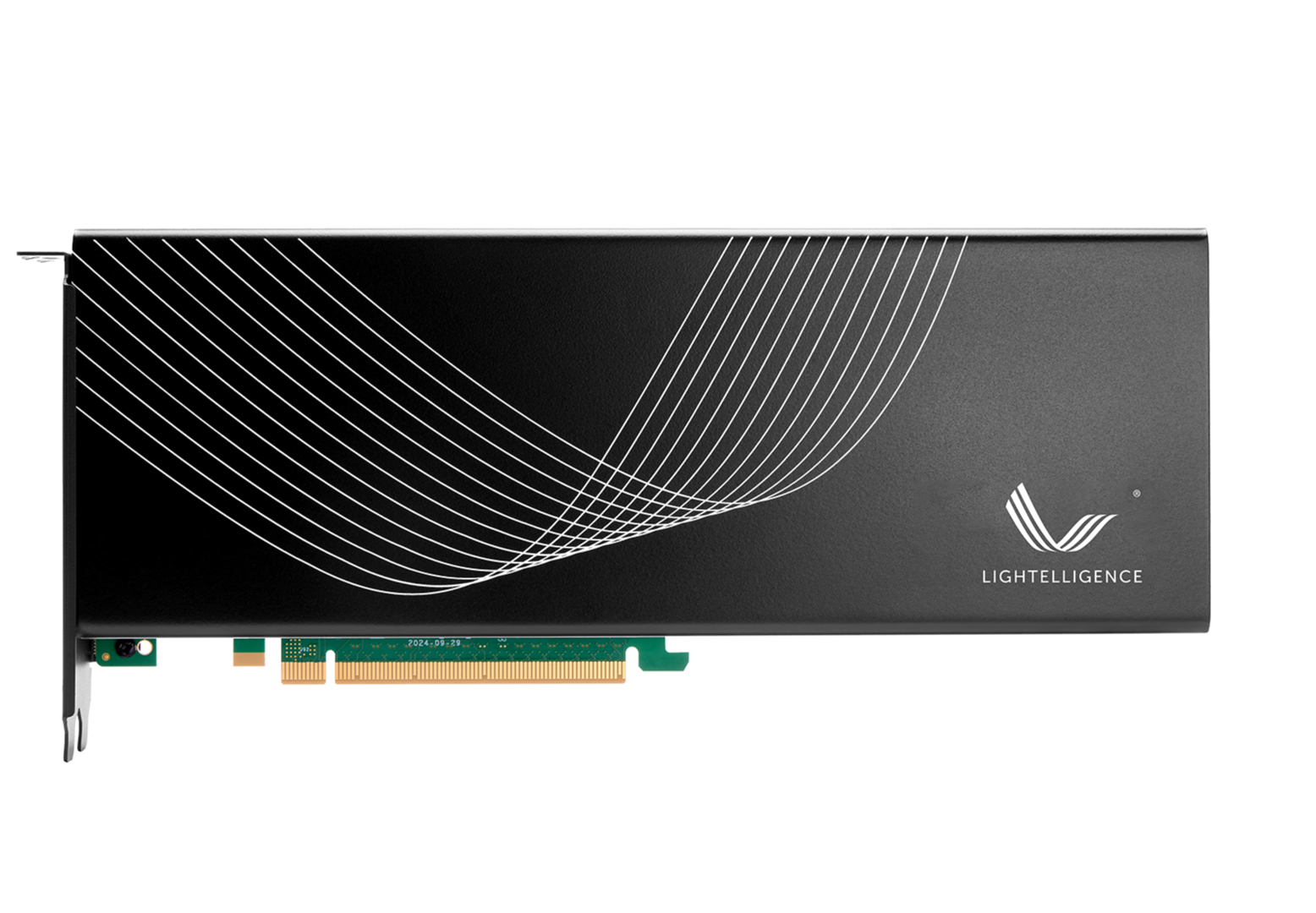
This work is built upon the PACE (Photonic Arithmetic Computing Engine) system-in-package platform, which has drawn significant industry attention. By integrating an optical multiply-accumulate (oMAC) compute core comprising a 2D array of Mach-Zehnder modulators (MZMs) on a silicon photonic chip, the system achieves truly "reconfigurable" functionality.
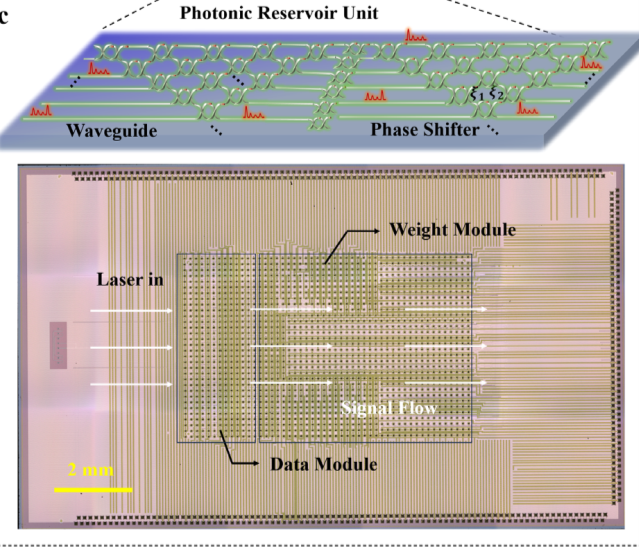
Figure 3: Optical micrograph of PACE, featuring a 64×64 optical matrix computing acceleration core
1. Ultra-High Computing Power and Ultralow Latency: The platform operates at a 1 GHz clock frequency, delivering up to 8.19 TOPS throughput, with each reservoir state update requiring only 3 ns of latency.
2. Freely Definable Topology and Density: Moving beyond fixed connections, the system supports flexible configuration of the reservoir layer according to task requirements. The study implemented multiple topological structures, including unidirectional coupling (RandF), bidirectional coupling (RandFB), and arbitrary sparse connections (Random), with fully adjustable connection density.
3. “Deep RC” Architecture via Spatial-Temporal Multiplexing: Leveraging the programmability of the hardware, the team proposed a scalable deep RC architecture. Through a spatial-temporal multiplexing strategy, the original 64 physical nodes were extended to over 600 effective reservoir nodes, greatly enriching the nonlinear processing capability of the system without the need to reconfigure the optical computing engine between layers, thus preserving processing speed.
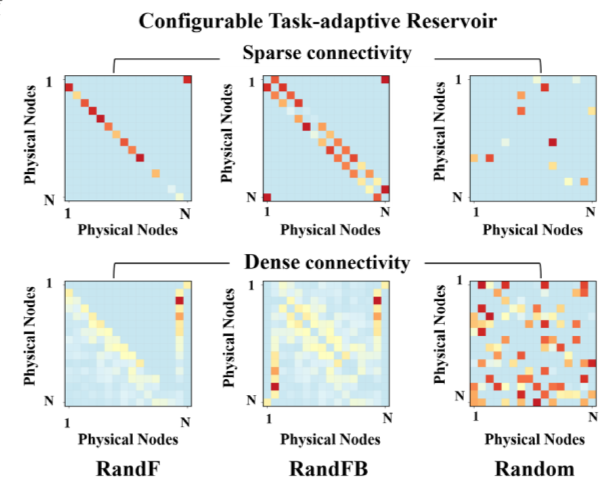
Representative topologies of the reservoir computing network, including RandF, RandFB, and Random topologies, supporting both sparse and dense connections
☆ Performance: Three Complex Tasks
To validate the generalization capability of this reconfigurable deep reservoir computing architecture, the research team conducted experimental benchmarks on three classic complex tasks in the fields of communications and machine vision, achieving state-of-the-art (SOTA) performance in all cases:
1. Modulation Format Identification (MFI) in Complex Channels
In optical communication channels with strong nonlinear distortion, the identification accuracy of a fixed feedforward topology (FixedF) drops to approximately 94.3%–92%. In contrast, the proposed system configured with sparse RandF and Random topologies maintains extremely high feature separability, achieving an accuracy of 99.8%–98.5%. Experimental results confirmed that the random sparse topology achieved a classification accuracy of 99.8% in this study.
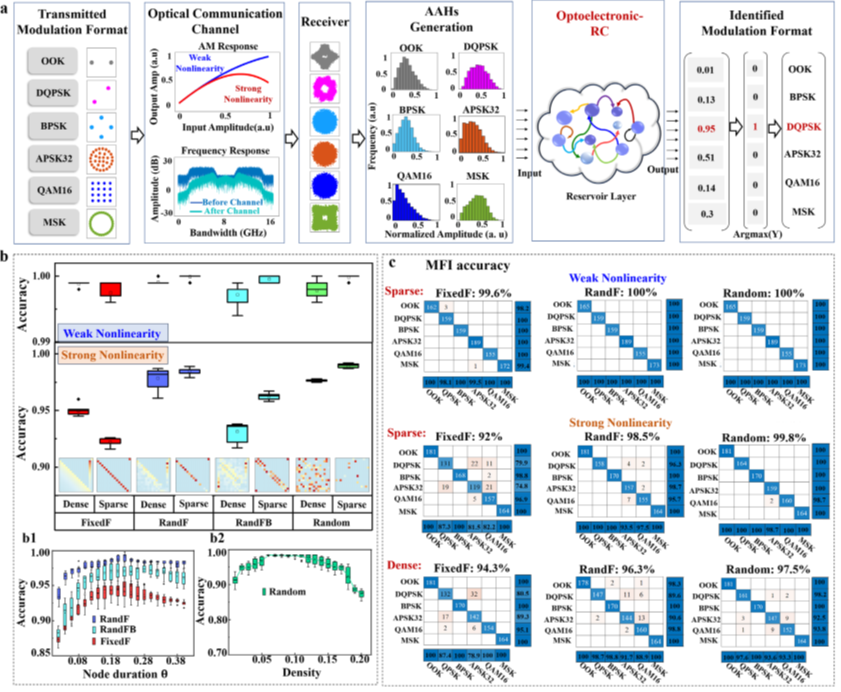
Application of the reconfigurable reservoir computing architecture in modulation format identification
2. Nonlinear Post-Equalization of Optical Communication Signals
For a 16-CAP modulated free-space optical communication (VLC) system, the team deployed a 5-layer (equivalent to 320 nodes) deep RC network. Under strong nonlinear distortion, the deep RC with a Random topology achieved a Q-factor improvement of 0.61 dB compared to the conventional quadratic Volterra series approximation algorithm, successfully pushing the bit error rate (BER) below the forward error correction (FEC) threshold.
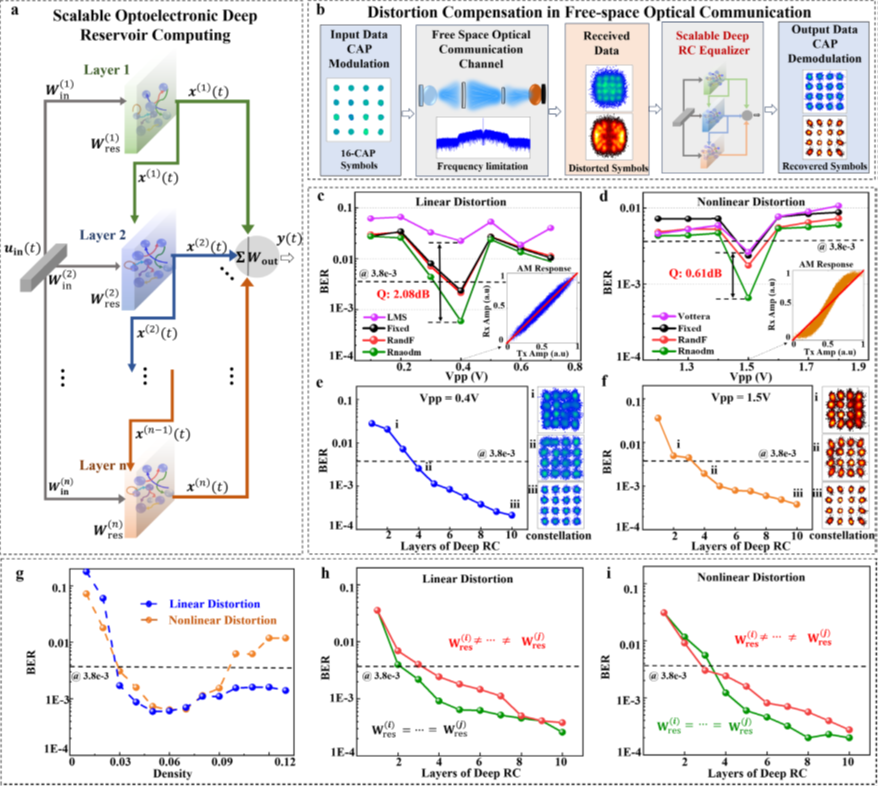
Figure 6: Performance of the scalable optoelectronic deep reservoir system
3. Image Classification (MNIST Dataset)
Beyond time-series signals, the architecture also performs impressively on spatial image processing tasks. By extracting features using HOG (Histogram of Oriented Gradients) and employing a 10-layer deep RandFB topology, the system achieved a high accuracy of 96.7% on MNIST handwritten digit recognition, surpassing the performance of most previous photonic RC processors.
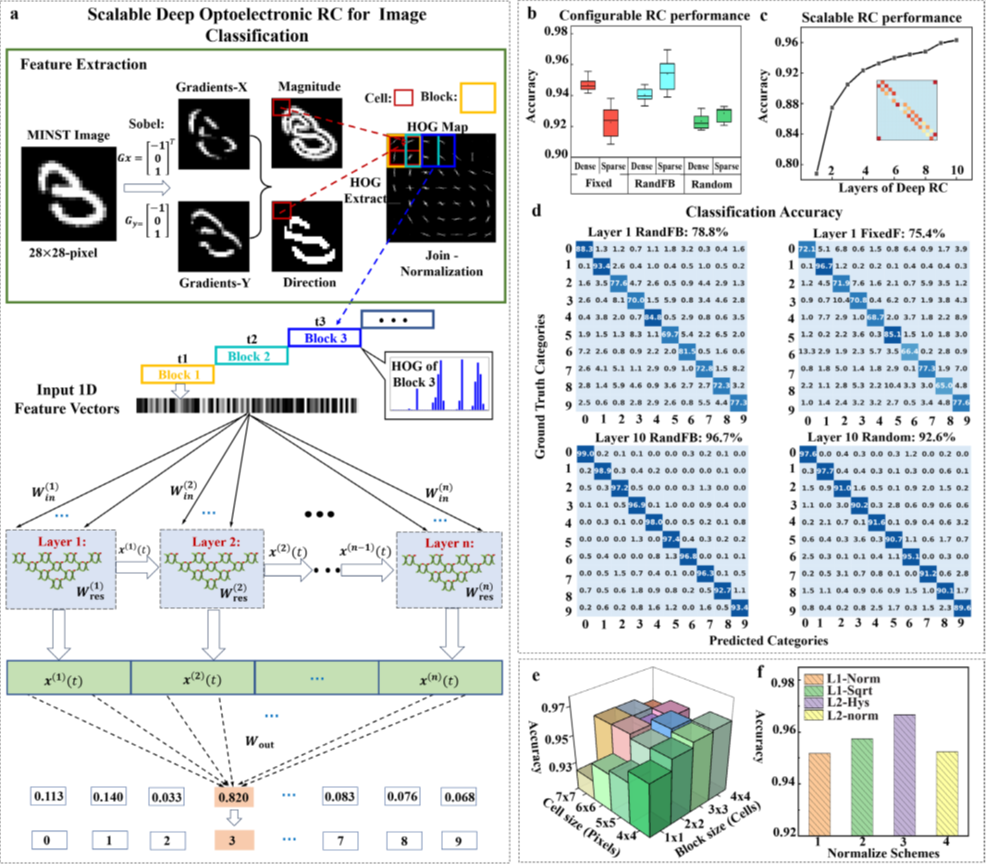
Figure 7: Experiment of the deep reservoir computing system on image classification tasks
☆ Summary and Outlook
This research provides a highly scalable and task-adaptive solution for high-speed optoelectronic neuromorphic computing. It demonstrates that the silicon photonic matrix architecture can not only perform linear transformations, but, when combined with flexible peripheral electronic control and deep multiplexing algorithms, is fully capable of handling complex high-dimensional nonlinear computations. This breakthrough paves the way for optical computing to move from the laboratory to real-world multi-task processing, such as speech recognition and chaotic time-series prediction.


